
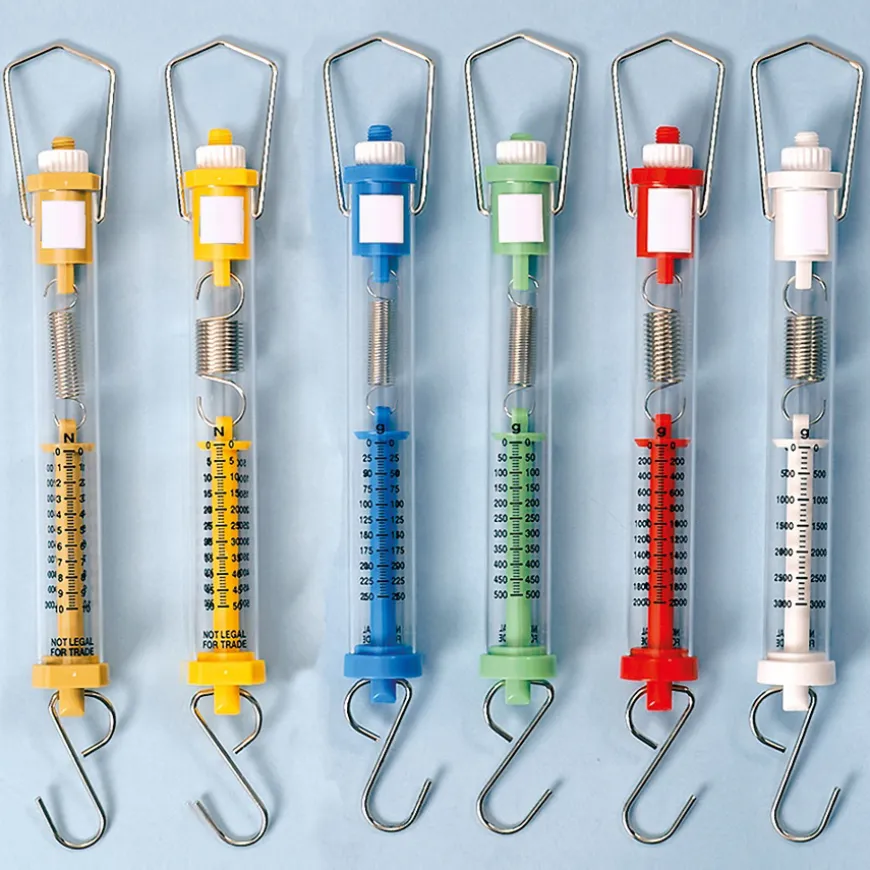
Spring Balance Force Meter In Newtons
£3.79
Helping to Support Teaching and Learning
-
Precise Calibration
-
These force meters are meticulously calibrated in Newtons and grams, ensuring precise measurements for accurate scientific exploration.
-
Durable Construction
-
Constructed from robust plastic, these meters boast a build designed to last, making them a reliable resource for busy classrooms.
-
Optimal Size
-
With a length of 160mm and a diameter of 20mm, these meters are perfectly sized for easy handling and storage.
-
Versatile Range
-
Available in six distinct sizes, offering versatility to meet the diverse needs of educational settings.
-
Science Support
-
Supports Science curriculum by enabling children to explore how mechanisms can amplify force, fostering a practical understanding of physics.
Spring Balance Force Meter In Newtons
Calibrated in Newtons and grams, these spring balances are essential for teaching forces and motion.
Overview
-
Essential for exploring forces, these spring balances are available in six sizes to cater to different educational needs and ages.
-
The spring balance force meters offer a rich educational experience by making force measurements tangible and understandable. Calibrated in both Newtons and grams, these tools bridge theoretical knowledge with practical application. Made from durable plastic and available in six sizes, they’re designed for longevity in diverse learning environments. Measuring 160mm in length and 20mm in diameter, they are suitable for hands-on experimentation.
-
Integral to the teaching of forces, the meters provide a solid foundation for conducting simple tests in Key Stage 1 and Lower Key Stage 2, reinforcing essential scientific enquiry skills.
-
Through facilitating practical investigations, these force meters promote an engaging approach to force measurement and teaching physics that sparks curiosity and enhances understanding among children, proving indispensable for dynamic science lessons.
Supports the National Curriculum
Science, Year 5, Forces
Recognise that some mechanisms including levers, pulleys and gears allow a smaller force to have a greater effect.
Science, Key Stage 1, Working Scientifically
Pupils should be taught to use practical scientific methods, processes and skills through performing simple tests.
Science, Lower Key Stage 2, Working Scientifically
Setting up simple practical enquiries, comparative and fair tests.
| Generic Size | 10N, 20N, 50N, 5N |
|---|
Be the first to review “Spring Balance Force Meter In Newtons”
Related products
Festivals & Celebrations
Babies & Toddlers

Communication, Language & Literacy
Exercise Books
Boxes & Containers
Early Years
Babies & Toddlers
Babies & Toddlers

Dens & Play Equipment
Art & Craft
Early Years
Babies & Toddlers
Festivals & Celebrations
Book Storage
Early Years
Reviews
There are no reviews yet.